
Marketing Project Management Software: The Complete Guide
What it is, how it works, and why the right platform determines how efficiently - and how consistently - your team delivers campaigns.
Marketing teams today are producing more content, across more channels, with more stakeholders involved in sign-off than at any point before. Yet most are still managing that complexity through spreadsheets, email threads, and disconnected tools – systems never designed for the structured, visible, auditable workflow that modern campaign delivery requires.
Purpose-built marketing project management software changes that. It gives marketing teams a single, centralised environment for planning campaigns, managing briefs, tracking tasks and resources, routing approvals, and reporting on delivery – from initial kick-off through to final sign-off.
This guide explains what marketing project management software is, how it works, the problems it solves, and what good looks like – whether you’re building a new process from scratch or replacing a set of tools that are no longer keeping up.
What Is Marketing Project Management Software?
Marketing project management software is a purpose-built platform that helps marketing teams plan, execute, and deliver campaigns from initial brief to final approval. Unlike general project management tools, it is designed specifically for marketing workflows – with native features for structured creative briefs, task and resource management, online proofing, multi-stage approval routing, compliance audit trails, and digital asset management, all in a single centralised platform.
The distinction from general project management tools matters. Platforms like Jira, Asana, and Monday.com were built for software development or business operations teams. They handle tasks and timelines well. What they don’t handle natively – and what marketing teams need – is structured brief capture, in-platform creative review with markup tools, multi-level approval routing with compliance checklists, and an audit trail that documents every decision made on an asset. Marketing teams using general PM tools typically bolt additional tools on top to fill these gaps, creating a fragmented, high-maintenance stack.
Marketing project management software provides these capabilities natively, in one platform – without the integrations, version confusion, and administrative overhead that multi-tool stacks generate. For a detailed feature-by-feature comparison, see Why Jira Isn’t Built for Marketing Teams.
Who uses marketing project management software?
Marketing project management software is used primarily by:
- In-house marketing teams managing high-volume campaign production across multiple channels and brands
- Creative and design teams who need structured briefs, clear task assignments, and consolidated feedback
- Marketing and Ad Agencies managing multi-client workflows, creative production, and client approvals
- Legal and compliance teams who review and sign off on regulated marketing content before it reaches market
- Marketing operations and project managers overseeing campaign delivery, resource allocation, and workflow governance across the team
- Financial services, insurance, health, and retail organisations where marketing compliance documentation is a regulatory requirement
How Marketing Project Management Software Works
Marketing project management software creates a structured, end-to-end workflow for every campaign – from the moment a brief is created through to final asset delivery and archiving. Here is how a well-designed platform manages the complete process.
1. Brief capture and project setup
Every campaign starts with a brief. Marketing project management software provides structured brief templates that capture deliverables, objectives, target audiences, deadlines, budget parameters, and compliance requirements upfront. The brief itself is routed through an approval stage before production begins – confirming that the project is correctly scoped and that all stakeholders are aligned before creative work starts. A poor brief is the single most common driver of avoidable revision rounds.
2. Project planning and task assignment
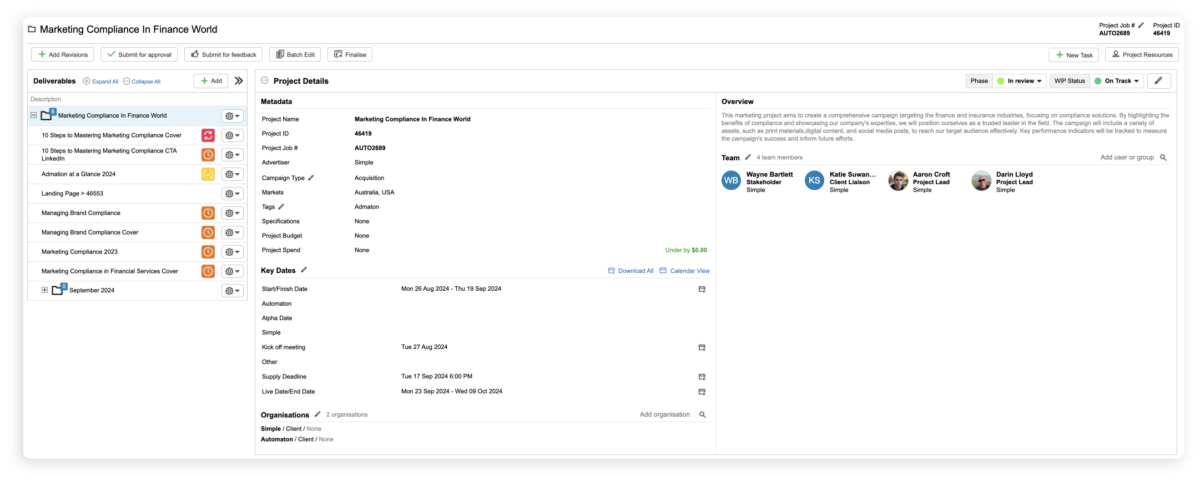
Once a brief is approved, the project manager builds the production plan – setting timelines, creating tasks, assigning work based on real-time resource availability, and configuring approval pathways for each deliverable. A centralised project dashboard gives the whole team visibility over what’s in progress, what’s due, and where responsibilities sit – without requiring manual status updates.
3. Creative production
The creative team works to the approved brief. Assets are stored and managed within the platform from the first draft onwards – creating a single, version-controlled record of every file. Task timers capture time spent, and project managers can track progress and workload against the planned timeline in real time.
4. Review and online proofing
Reviewers annotate and comment directly on creative assets using online proofing tools – marking up specific copy, flagging design elements, and noting compliance language – with feedback consolidated in one place, visible to all reviewers simultaneously. This replaces the fragmented, duplicated input that email review generates and gives creative teams one clear set of changes to action.
5. Approval routing and sign-off
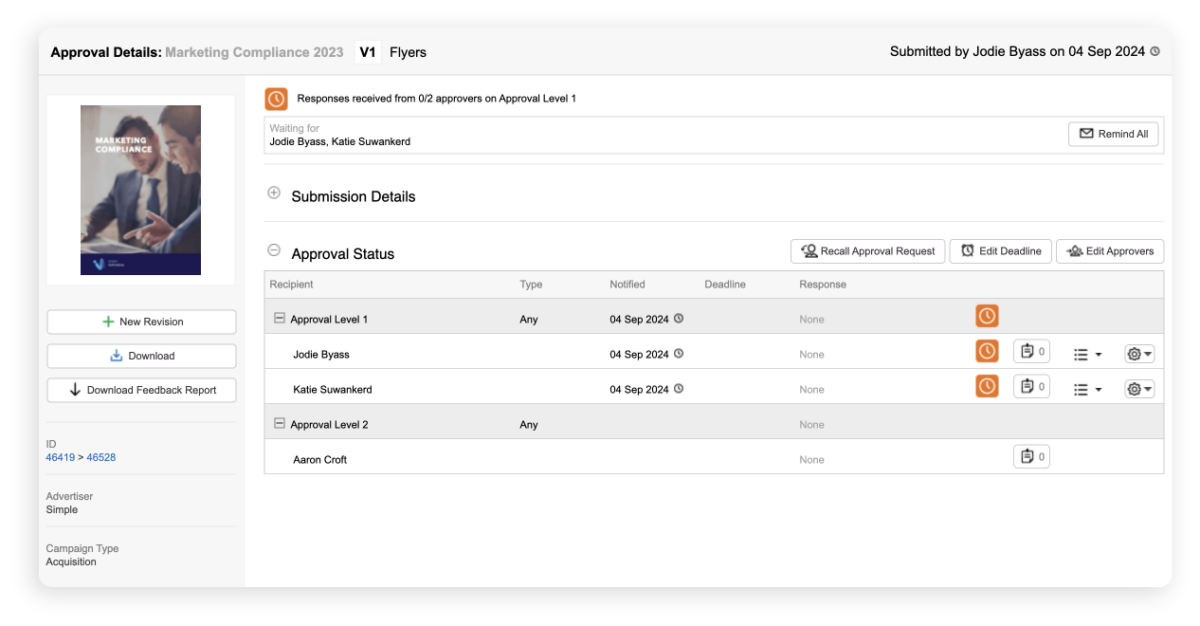
Custom approval pathways define who reviews each asset and in what sequence. Creative review, brand sign-off, legal and compliance review, and senior approval each happen at the defined stage – not whenever someone happens to check their email. Assets move automatically to the next stage when the required sign-offs are received. Automated reminders keep the process moving without manual chasing.
6. Version control and revision management
When changes are requested, updated versions are uploaded and tracked automatically. Version history is maintained without any manual filing – and side-by-side comparison confirms that every requested change has been implemented before an asset re-enters the approval sequence. No version confusion, no assets progressing with outstanding changes unresolved.
7. Final delivery and archiving
Once all required approvals are received, the asset is marked as complete and archived with its full approval history – every comment, version, and sign-off documented with a timestamp and user attribution. The audit trail this generates is the compliance record that regulated industries require, and the operational record that helps teams improve future campaigns.
Key Benefits of Marketing Project Management Software
The following benefits are consistently realised by marketing teams that move from informal, spreadsheet-and-email-based processes to a purpose-built platform. For a full breakdown, see Project and Resource Management – Features and Benefits.
Complete visibility across every active campaign
A centralised project dashboard gives marketing managers real-time visibility over every campaign simultaneously – task status, resource availability, approval progress, and delivery milestones – without requiring manual status updates from the team. Bottlenecks are visible before they become missed deadlines.
Fewer revision rounds and faster campaign delivery
Structured briefs reduce misaligned creative work from the first draft. Consolidated, contextual feedback – provided directly on the asset through online proofing tools – reduces the ambiguity and duplication that drive unnecessary revision rounds. The result is faster delivery with less rework, across every project.
Better resource utilisation
When task assignment is based on real-time resource availability – not assumptions – workloads are distributed more effectively. WIP reporting and time tracking give managers the data they need to plan resourcing for upcoming campaigns before capacity constraints become delivery problems.
Improved compliance and reduced risk
In regulated industries, a structured workflow is the primary mechanism for ensuring content meets legal and regulatory requirements before it reaches market. Routing content through compliance and legal review as a mandatory workflow stage – not an optional step – systematically reduces the risk of non-compliant content reaching market. The audit trail generated provides documented evidence of every approval decision.
Consistent process across teams, brands, and geographies
When workflows are template-driven, every project follows the same structure – the same brief format, the same approval sequence, the same compliance checks – regardless of which team member is managing it, which brand it’s for, or which market it’s serving. Consistency at scale is not achievable through informal coordination; it requires a structured platform.
Full audit trail and accountability
Every action on every project – every task update, comment, change request, version upload, approval decision, and sign-off – is logged with a timestamp and user attribution in a complete audit trail. This record is generated automatically, without any additional effort from the team, and is available for compliance review, operational analysis, or dispute resolution at any point.
The Problems with Informal Marketing Project Management
Understanding why purpose-built software matters requires understanding what it replaces. The following problems are endemic to marketing teams managing campaigns through spreadsheets, email, and disconnected tools – and they are the direct cause of most delayed campaigns, costly revision cycles, and compliance failures.
No single source of truth
When project information is spread across email inboxes, shared drives, chat channels, and spreadsheets, there is no authoritative record of what has been agreed, what has been approved, and what the current status of any given project actually is. Team members work from different assumptions. Managers spend significant time simply establishing what is happening rather than managing what comes next.
Version control breaks down under volume
When assets are distributed by email or shared drive link, version control fails quickly. Stakeholders review different versions simultaneously. Conflicting feedback is actioned at the same time. Updated files are sent back with names like ‘Final_FINAL_v3_approved_use this.pdf’. Version sprawl is one of the most common and most costly problems in creative production – and it is almost entirely caused by the absence of a structured workflow. See why marketing teams are replacing spreadsheets with dedicated software.
Compliance review gets skipped under pressure
In informal workflows, compliance and legal review steps get bypassed – not deliberately, but because there is no mechanism that enforces them. An asset progresses when someone believes it is ready, not when every required sign-off has been obtained. For regulated industries – financial services, insurance, health and pharmaceuticals – this is not an inefficiency. It is a liability.
Resource problems are invisible until it’s too late
Without visibility into team workload and capacity, resource problems surface only when deadlines are at risk. There is no early warning when a team member is overloaded, no mechanism for proactively redistributing work, and no data to support realistic planning for upcoming campaigns. See the cost of not having marketing project management software.
Approval bottlenecks are undetectable until they become crises
In an informal process, the only way to discover an approval bottleneck is when a deadline is missed. There is no dashboard showing which approvals are outstanding, which reviewers have not responded, or which projects are at risk. By the time the problem is visible, the delay has already occurred.
Scaling is structurally impossible
Informal processes work – poorly – at small scale. As team size grows, campaign volume increases, or new brands and markets are added, the coordination overhead of informal management grows faster than the team’s capacity to absorb it. Processes that function for ten projects a month will not function for forty. Purpose-built software is what makes scale manageable.
When to Implement Marketing Project Management Software
Most marketing teams already have some form of project coordination – the question is whether it is structured enough to scale reliably. Consider implementing purpose-built software if:
- Campaign information is managed primarily through email, shared drives, or spreadsheets
- Version control is unreliable – team members regularly work from outdated files or conflicting versions
- Revision counts per project are consistently higher than they should be
- Compliance review steps are difficult to document or are being missed under deadline pressure
- External stakeholders – agencies, clients, freelancers – are difficult to coordinate and review assets by email
- Campaign delivery deadlines are regularly missed due to approval delays
- There is no reliable, real-time view of project status across the team
- Your organisation operates in a regulated industry where documented sign-off is required by law or internal governance
- Team size, campaign volume, or geographic spread is growing and the current process isn’t keeping up
If three or more of these apply, the cost of the informal process – in time, rework, compliance risk, and campaign delays – almost certainly exceeds the cost of implementing a structured platform. See also: Signs your team is ready for marketing project management software.
Essential Features of Marketing Project Management Software
Not all marketing project management software is built the same. General-purpose tools can be configured to handle some of these requirements; purpose-built platforms include them natively. Here is what a comprehensive platform should include.
Structured brief templates
The brief is where every campaign starts, and the quality of the brief determines the quality of everything that follows. Look for platforms that provide customisable brief templates – with mandatory fields for objectives, deliverables, compliance requirements, and deadlines – and that route briefs through their own approval stage before production begins.
Project dashboard and marketing calendar
A centralised project dashboard should provide real-time visibility over every active campaign – task status, approval progress, resource allocation, and upcoming deadlines – updated automatically as the project progresses. A live marketing calendar that updates as new projects are created gives management an always-current view of campaign activity across the team.
Task management and resource scheduling
Effective task management includes creating and assigning tasks based on real-time resource availability, setting dependencies and deadlines, tracking progress, and reassigning work when priorities shift. Resource scheduling tools that show individual workloads and capacity across the team allow managers to plan forward without overloading the team.
Approval workflow automation
Configurable approval pathways allow teams to define exactly who reviews each asset and in what sequence – sequential review, parallel review, conditional routing, and role-based access all configurable without technical support. Automated notifications and reminders remove the manual chase from approval management.
Online proofing and markup
The ability to review and annotate creative assets directly in the platform – across all file types your team produces, including PDFs, images, video, and HTML – is fundamental. Online proofing tools consolidate feedback, eliminate version confusion, and give creative teams one unambiguous set of changes to action. Platforms that require assets to be downloaded, marked up externally, and re-uploaded negate most of the benefit.
Version control
Automatic version control means the platform maintains a complete history of every file uploaded – with side-by-side comparison to confirm that all requested changes have been implemented before the revised asset enters the next review stage. This eliminates one of the most common sources of delay and error in creative production.
Compliance tools and audit trail
For teams in regulated industries, compliance is non-negotiable. Look for platforms that include approval checklists – requiring reviewers to confirm specific compliance checks before sign-off can be given – and that generate a complete, timestamped audit trail of every action taken on every project. This record should be exportable for compliance review without any additional effort.
WIP reporting and analytics
Real-time WIP reporting gives managers visibility into campaign progress, revision counts, resource utilisation, and delivery performance across all active projects simultaneously. Reporting tools that surface this data in visual, shareable formats reduce the manual reporting burden and support better operational decision-making.
Digital asset management
Platforms that integrate digital asset management allow approved assets to move automatically from the production workflow into a centralised, searchable library – without manual transfers. This closes the loop between production and asset use, and ensures that teams always work from approved, current versions of brand materials.
Remote and distributed team support
Cloud-based platforms that allow any team member – internal or external – to access briefs, files, tasks, and approvals from anywhere are a baseline requirement, not a premium feature. External stakeholder access for clients, agencies, and freelancers should be seamless, not bolted on.

The Five Phases of Marketing Project Management
Effective marketing project management follows a consistent structure regardless of campaign type or team size. Here is how each phase works, and how software supports it.
1. Planning
The planning phase defines the campaign’s objectives, deliverables, timeline, and resource requirements. Marketing project management software supports planning with structured brief templates, project setup tools that organise all files and stakeholders from the start, and timeline builders that translate the plan into assigned tasks and milestones.
2. Organising
Once the plan is set, the organising phase builds the production structure – assigning tasks, configuring approval pathways, setting dependencies, and establishing the marketing calendar that all stakeholders will work to. Gantt charts and Kanban-style views give managers a visual map of the project timeline and task dependencies before production begins.
3. Execution
The execution phase is where creative work happens. Marketing project management software supports execution with real-time task tracking, time logging, online proofing and collaboration tools, and automated notifications that keep the team informed without manual coordination. Managers can monitor progress against plan continuously and address emerging issues before they affect delivery.
4. Control
The control phase monitors campaign progress against the plan and makes adjustments when needed. Dashboard reporting gives real-time visibility into task completion, resource utilisation, approval status, and potential bottlenecks. When issues emerge, the platform provides the data needed to make informed adjustments – reallocating resources, revising timelines, or escalating outstanding approvals – before they become delivery failures.
5. Delivery
The delivery phase obtains final sign-off, archives completed assets, and closes the project. Approval workflow software streamlines final sign-off, ensuring every required reviewer has confirmed their approval before the campaign goes to market. The complete audit trail – every brief version, comment, approval decision, and final file – is archived and accessible for compliance review, performance analysis, or future campaign planning.
Selecting the Right Marketing Project Management Software
Choosing a platform is a significant decision that affects how every member of your marketing team works every day. The following framework covers the key evaluation factors. For a detailed guide to the selection process, see How to Choose Marketing Project Management Software.
1. Identify your team’s specific requirements
Before evaluating platforms, establish what your team needs – not what a vendor’s feature list says you need. Consider the volume and complexity of campaigns you manage, the compliance requirements you operate under, the number of external stakeholders involved in approvals, and the current tools your team is using. The gap between what you have and what you need defines the requirements any platform must meet.
2. Evaluate whether the platform is purpose-built for marketing
General project management tools – Jira, Asana, Monday.com – handle tasks and timelines but lack native marketing-specific capabilities. Confirm that any platform you evaluate includes structured creative briefs, in-platform online proofing across all your file types, configurable approval routing, compliance checklists, and audit trail generation – not as integrations, but as built-in features.
3. Assess compliance and audit capabilities
For organisations in regulated industries, compliance capabilities are not a secondary consideration. Confirm that the platform generates a complete, exportable audit trail, supports approval checklists that enforce compliance steps before sign-off, and provides role-based access controls that prevent unauthorised actions on sensitive content.
4. Consider user experience and adoption
A platform that is difficult to use will not be used consistently – which defeats its purpose. Prioritise platforms with clean, intuitive interfaces that require minimal training. Most vendors offer free trials or demos: use them, and involve the team members who will use the platform daily – not just the decision-makers evaluating it.
5. Evaluate scalability and integration
The platform needs to grow with your team. Assess whether it can handle more users, more campaigns, and more brands without degrading in performance or usability. Evaluate integration with your existing marketing technology stack – including digital asset management, CRM, and creative tools – and confirm that integration is native rather than reliant on third-party connectors.
6. Test, then implement
Narrow your shortlist to two or three platforms and run structured trials with real projects. Involve key stakeholders in the evaluation. Gather feedback on usability, feature completeness, and fit with existing workflows before making a final decision. The most common implementation failure is poor adoption – choose a platform your team will actually use and invest in the onboarding process that ensures they do.
Marketing Project Management in 2026: Trends Shaping the Category
The marketing project management software category is evolving rapidly. Three trends are reshaping what teams should expect from platforms – and what to look for when evaluating them now.
AI-assisted planning and workflow intelligence
AI is entering marketing project management in practical, workflow-embedded ways: automated brief analysis that flags missing information before production begins, intelligent task prioritisation based on resource availability and deadline proximity, and predictive identification of approval bottlenecks before they affect delivery. These capabilities are early-stage in most platforms but are developing quickly. Teams evaluating platforms now should ask vendors about their AI roadmap and the specific workflow problems their AI features are designed to solve – not just whether AI features exist.
Integrated end-to-end platforms replacing tool stacks
The direction of the market is unambiguous: standalone project management tools, standalone proofing tools, and standalone DAM platforms are being replaced by integrated platforms that connect project management, online proofing, resource management, and digital asset management in a single environment. Teams that adopt integrated platforms now will have a structural efficiency advantage over those maintaining multiple disconnected tools with the associated integration overhead and data fragmentation.
Compliance as a built-in capability, not an afterthought
The growing complexity of marketing regulations – across financial services, health and pharmaceuticals, and consumer sectors – is making built-in compliance tools a standard expectation rather than a premium feature. Platforms that embed compliance checklists, enforce mandatory review stages, and generate defensible audit trails are increasingly the default choice for regulated industries. Teams operating under compliance obligations who are not using purpose-built tools are carrying a risk that does not have to exist.
Marketing Project Management Best Practices
Software supports a well-run process, but it doesn’t replace one. The following practices consistently differentiate high-performing marketing teams from those that struggle with delivery, quality, and compliance – regardless of the tools they use.
Start with the brief, every time
The single highest-return improvement most marketing teams can make is treating the brief as a formal approval stage, not a formality. A signed-off creative brief that captures objectives, deliverables, compliance requirements, and stakeholder expectations in full – before any creative work begins – eliminates the misaligned scope and late-stage scope changes that are the primary driver of unnecessary revision rounds.
Sequence reviewers, don’t broadcast
Not every stakeholder needs to see every version at every stage. Creative review, brand sign-off, and legal and compliance review should happen in the right sequence – which means legal is not reviewing early-stage creative that will change significantly, and brand is not commenting on copy that legal has not yet cleared. Sequenced review reduces overall revision rounds and produces less contradictory feedback.
Consolidate feedback before it reaches the creative team
The creative team should receive one set of feedback, not five separate inputs from five different reviewers. Consolidated, deduplicated feedback is faster to action, less likely to be contradictory, and far less likely to generate a follow-up clarification round. Online proofing tools that make all reviewer feedback visible simultaneously – and allow reviewers to see and respond to each other’s comments – make this achievable without additional coordination effort.
Use templates to enforce consistency
Templates for briefs, project structures, and approval pathways ensure that every project follows the same process – regardless of which team member is managing it. Consistency at scale is what transforms a process from something that works when the right people are in the room into something that works reliably across the whole team, every time.
Monitor and act on WIP data proactively
The purpose of WIP reporting is not to create documentation – it is to give managers the information they need to make proactive decisions about resourcing, timelines, and approval prioritisation before problems become delivery failures. Teams that review WIP data regularly, and adjust plans in response, consistently outperform those that use reports only for retrospective analysis.
Admation: Marketing Project Management Software for Campaign Teams
For marketing teams looking for a platform that covers the full campaign management lifecycle, Admation combines marketing project management, online proofing, resource management, and digital asset management in a single platform – without requiring teams to manage integrations between separate tools.
Where most project management tools manage tasks and timelines, Admation manages the complete creative production cycle – from structured project briefing through to online proofing, compliance checklists, audit trail generation, and final asset archiving. This is particularly valuable for marketing teams in regulated industries – financial services, insurance, health and pharmaceuticals – where compliance documentation and approval accountability are as important as delivery speed. Admation is used by marketing teams at Woolworths, Bendigo Bank, Great Southern Bank, Bank Australia, Tourism Australia and RACV.
Frequently Asked Questions
What is marketing project management?
Marketing project management is the process of planning, coordinating, and overseeing marketing campaigns and creative projects to ensure they are delivered on time, within budget, and to the required quality and compliance standard. It covers everything from campaign briefs and task assignment through to creative production, stakeholder approvals, and final asset delivery – and in regulated industries, the compliance documentation that demonstrates the process was followed correctly.
What is the difference between marketing project management and general project management?
General project management covers task assignment, timelines, and team coordination across any type of work. Marketing project management includes additional capabilities specific to campaign production – structured creative briefs, online proofing with markup tools, multi-round revision management, multi-stage approval routing with compliance checklists, and campaign reporting. General project management tools can be configured to handle some of these requirements, but typically require additional tools to cover the gaps that purpose-built marketing project management software addresses natively.
What are the five phases of marketing project management?
Effective marketing project management follows five phases: Planning (defining objectives, deliverables, timelines, and resources), Organising (building the production structure – tasks, approval pathways, and the marketing calendar), Execution (creative production, task completion, and real-time progress tracking), Control (monitoring against plan and making adjustments when needed), and Delivery (obtaining final sign-offs, archiving completed assets, and closing the project with a complete audit trail).
What features should marketing project management software include?
The core features a comprehensive platform should include are: structured brief templates with brief approval, project dashboards with real-time visibility, task management and resource scheduling, configurable approval workflow automation, online proofing and markup across all file types, automatic version control, compliance checklists and audit trail generation, WIP reporting and analytics, and integration with digital asset management. Purpose-built platforms include these natively; general PM tools typically require additional tools to fill the gaps.
What is the difference between marketing project management and marketing resource management?
Marketing project management focuses on planning and delivering specific campaigns and creative projects – briefs, tasks, timelines, approvals, and delivery. Marketing resource management focuses on the people and capacity behind those projects – who is available, what their workload is, how time is being allocated across the team, and how to plan resourcing for upcoming campaigns without overloading individuals. Modern platforms like Admation combine both capabilities in a single system, so project delivery and resource planning are managed in the same environment rather than separately.
How does marketing project management software support compliance in regulated industries?
Marketing project management software supports marketing compliance in three ways. First, it routes content through legal and compliance review as a mandatory workflow stage – not a step that can be skipped under deadline pressure. Second, approval checklists require reviewers to confirm specific compliance checks before sign-off can be given. Third, the audit trail generated automatically documents every review action, approval decision, and version change with a timestamp and user attribution – providing the evidence that regulators require and protecting organisations when content decisions are challenged.
Related Resources
Marketing Project Management Software
How Admation manages the complete campaign lifecycle - planning, execution, approvals, and reporting - for marketing teams. Learn more about Project Management

Marketing Project Management Best Practices
Step-by-step best practices, common mistakes, and templates for high-volume marketing teams. Read the complete guide

Marketing Approval Workflow Software
How Admation automates multi-stage approval routing and sign-off governance. Learn more about Approval Workflow

Online Proofing Software
Review, annotate, and approve creative assets with markup tools and version control built into the workflow. Learn more about Online Proofing

Marketing Resource Management
Plan team capacity, scheduling, and workload alongside campaign delivery. Learn more about Resource Management

Marketing Compliance Software
Structured checklists, tiered approvals, and audit trails for regulated marketing environments. Learn more about Marketing Compliance