
Marketing Approval Workflow: The Complete Guide
What it is, how it works, and why the way you manage approvals determines how fast - and how safely - your marketing gets to market.
Marketing teams today are producing more content, across more channels, with more stakeholders involved in sign-off than ever before. Yet most are still managing that complexity through email threads, shared spreadsheets, and informal Slack messages – tools that were never designed for structured approval governance.
A well-designed marketing approval workflow changes that. It gives every stakeholder a clear role, every asset a documented path to sign-off, and every decision a timestamped record. This guide explains what a marketing approval workflow is, how it works, the problems it solves, and what good looks like – whether you’re building one from scratch or fixing a broken process.
Already evaluating software? Skip to Approval Workflow Software or download the Guide to Selecting the Right Marketing Approval Workflow Software.
What Is a Marketing Approval Workflow?
A marketing approval workflow is the structured process a marketing team uses to review, refine, and sign off on content before it is published or distributed. It defines who reviews what, in what order, what each reviewer must confirm, and what documentation is required at every stage.
Unlike an ad hoc email chain, a marketing approval workflow is systematic. It applies the same structure – the same reviewers, the same sequence, the same compliance checks – consistently across every piece of content. That consistency is what makes it valuable: it prevents shortcuts, reduces errors, and ensures that regulated content is always reviewed by the right people before it reaches market.
The terms ‘marketing approval process’ and ‘marketing approval workflow’ are often used interchangeably. In practice, the process describes the steps involved; the workflow describes how those steps are structured, sequenced, and automated within a platform.
Who is involved in a marketing approval workflow?
A marketing approval workflow typically involves:
- Content creators and designers who produce the asset and incorporate feedback
- Marketing managers who review for strategic alignment, brief accuracy, and brand consistency
- Brand teams who confirm adherence to visual and verbal brand guidelines
- Legal and compliance teams who review regulated claims, disclosures, and financial or health language
- Senior stakeholders or clients who provide final commercial sign-off
- Project managers who oversee routing, deadlines, and workflow progress
In regulated industries – financial services and insurance, health and pharmaceuticals, agencies – legal and compliance review is not optional. The approval workflow is the mechanism that ensures it happens reliably, and the audit trail it generates is what demonstrates it happened at all.

How a Marketing Approval Workflow Works
A structured marketing approval workflow takes every asset from brief to final sign-off through a defined sequence of stages. Here is how a well-designed process works in practice.
1. Brief capture and project setup
Every approval workflow starts before creative work begins. A structured brief captures deliverables, deadlines, target audience, brand requirements, and compliance considerations upfront – and is itself routed through an approval stage to confirm the project is correctly scoped before production starts. A poor brief generates more revision rounds than any other single factor.
2. Creative production
The creative team works to the approved brief. Assets are uploaded directly into the workflow platform rather than distributed by email – creating a single, version-controlled record of every file from the first draft onwards.
3. Internal review and markup
Reviewers annotate and comment directly on the asset using online proofing tools – marking up specific copy, highlighting design elements, flagging compliance language. Feedback is consolidated in one place, visible to all reviewers simultaneously, eliminating the duplicated and contradictory input that email review generates.
4. Approval routing
Custom approval pathways define who reviews each asset and in what sequence. Creative review, brand sign-off, legal and compliance review, and client or senior approval each happen at the defined stage – not whenever someone happens to pick up an email. Assets move automatically to the next stage when the required sign-offs are received.
5. Revision and version control
When changes are requested, the creative team revises and uploads a new version. Version history is maintained automatically. Side-by-side comparison confirms every requested change has been implemented before the revised asset re-enters the approval sequence. No version confusion, no assets progressing with outstanding changes.
6. Final sign-off and archiving
Once all required approvals are received, the asset is marked as complete. The full approval history – every comment, change request, version, and sign-off – is archived. For regulated industries, this documented record is the audit trail that demonstrates the content was approved appropriately.
New to approval workflows? Download the Quick Start Guide to Understanding Approval Workflow Solutions for a practical introduction.
Key Benefits of a Structured Marketing Approval Workflow
The following benefits are consistently realised by marketing teams that move from informal, email-based approval processes to a structured workflow. For a full breakdown, see the 10 Benefits of Approval Workflow Software.
Improved compliance and reduced risk
In regulated industries, a structured approval workflow is the primary mechanism for ensuring content meets legal and regulatory requirements before it reaches market. By routing content through compliance and legal review as a mandatory workflow stage – not an afterthought – teams systematically reduce the risk of non-compliant content, and the audit trail provides documented evidence of every approval decision.
Fewer revision rounds and faster delivery
When feedback is consolidated, contextual, and visible to all reviewers at the same time, revision cycles shorten significantly. Reviewers stop duplicating comments. Designers know exactly what to change. Version comparison confirms changes have been implemented before the next review stage begins. Campaigns reach market faster with fewer rounds of rework.
Full transparency across every project
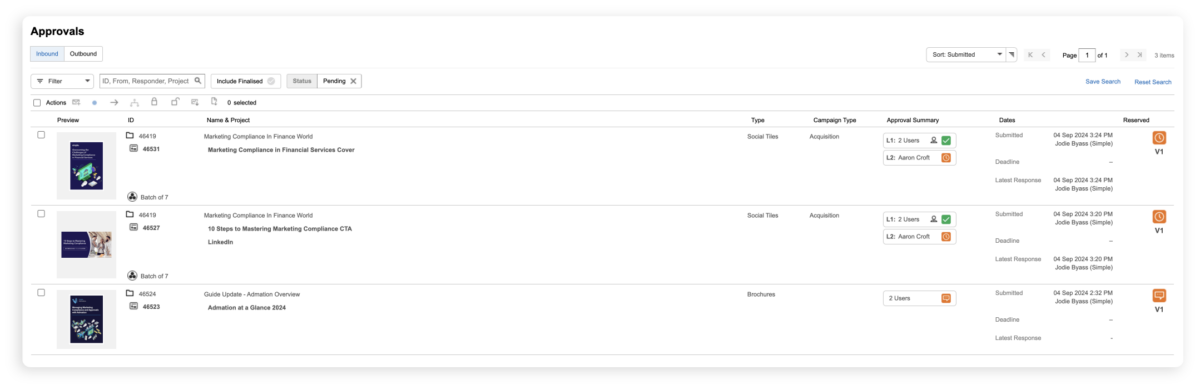
A structured workflow gives every stakeholder – creators, managers, legal, clients – real-time visibility into where every asset sits in the approval process. Pending approvals are visible. Bottlenecks are identifiable. There is no ambiguity about who is responsible for the next action.
Better briefs and less rework at source
Routing briefs through a formal approval stage before production begins is one of the highest-return changes a marketing team can make to its workflow. A confirmed, signed-off brief reduces mid-production scope changes, reduces the revision rounds driven by misaligned expectations, and improves the quality of creative output from the first draft.
A complete audit trail for compliance and accountability
Every comment, version upload, approval decision, and forwarded action is logged with a timestamp and user attribution. This record is available throughout the project lifecycle and exportable for compliance review. For financial services, insurance, and health marketing teams, this documented history is not a nice-to-have – it is a regulatory requirement.
Building the business case internally? Download the 10 Benefits of Approval Workflow Software.
The Problems with Informal Approval Processes
Understanding why a structured marketing approval workflow matters requires understanding what it replaces. The following problems are endemic to informal, email-based approval processes – and they are the direct cause of most delayed campaigns, expensive revision cycles, and compliance failures in marketing teams.
Email approvals do not scale
Email is designed for one-to-one communication. Marketing approval involves multiple reviewers, multiple assets, multiple versions, and multiple simultaneous projects. The result is threads that fragment across inboxes, feedback that arrives out of sequence, and no shared view of what has been approved and what has not. See why email approvals are an outdated approach and why the complexity they were never designed to handle grows with every campaign.
Version control fails under pressure
When assets are distributed by email or shared drive link, version control breaks down quickly. Stakeholders review different versions. Conflicting feedback is actioned simultaneously. Updated files are emailed back with names like ‘Final_v3_APPROVED_use this one.pdf’. Version sprawl is one of the most common and most costly problems in creative production – and it is almost entirely caused by the absence of a structured workflow. See How to identify and fix bottlenecks in your approval workflow.
Compliance review gets bypassed
In informal workflows, compliance and legal review steps get skipped – not deliberately, but because there is no mechanism that enforces them. An asset progresses when someone says it is ready, not when every required reviewer has signed off. For regulated industries, this is not just an inefficiency. It is a liability.
There is no reliable audit trail
When approvals happen across email threads and chat messages, no coherent record exists. If a compliance issue surfaces after publication, there is no way to demonstrate that the required sign-offs were obtained. The documentation that regulators require – and that protects teams when content is challenged – simply does not exist.
Bottlenecks are invisible until they become crises
In an informal process, the only way to discover a bottleneck is when a deadline is missed. There is no dashboard showing which approvals are outstanding, which reviewers are behind, or which projects are at risk. Read how to identify and fix approval workflow bottlenecks. Also see what marketing approvals really cost when processes stay informal.
When to Formalise Your Marketing Approval Workflow
Most teams already have some form of approval process – the question is whether it is structured enough to scale and reliable enough to protect the organisation. Is it time to review your marketing approval process? Consider formalising if:
- Approval feedback is being managed primarily through email or messaging tools
- Version control is unreliable – teams regularly work from outdated files
- Revision counts per project are higher than they should be
- Compliance review steps are difficult to document or are being missed
- External stakeholders – clients, agencies, freelancers – are difficult to coordinate
- Campaigns are regularly delayed due to outstanding approvals
- There is no clear, real-time view of where projects stand in the sign-off process
- Your team is in a regulated industry where documented sign-offs are required
If three or more of these apply, the cost of the informal process – in time, rework, compliance risk, and campaign delays – almost certainly exceeds the cost of implementing a structured solution.
What a Good Marketing Approval Workflow Looks Like
The principles below describe what separates a high-functioning approval workflow from one that slows teams down rather than accelerating them. For a full step-by-step setup guide and best practices, see the Complete Guide to Marketing Approval Workflow Best Practices.
The brief is approved before production begins
The brief is the first approval stage, not a formality. A signed-off brief prevents the scope changes, misaligned expectations, and late-stage revisions that are the single biggest driver of avoidable rework.
Reviewers are sequenced, not simultaneous
Not every stakeholder needs to see every version at every stage. Creative review, brand sign-off, and legal review happen in the right order – which means legal is not reviewing early-stage creative that will change significantly, and brand is not commenting on copy that legal has not yet cleared. The right reviewers at the right stages reduces overall revision rounds.
Feedback is consolidated before it reaches the creative team
The creative team should receive one set of feedback, not five separate inputs from five different reviewers. Consolidated, deduplicated feedback is faster to action, less likely to be contradictory, and far less likely to generate a follow-up round of clarification. See also: how to provide effective feedback in marketing approvals.
Compliance is enforced at every stage
A well-designed workflow uses approval checklists to enforce compliance steps before sign-off can be given. Reviewers confirm each required check is complete – not just that they’ve reviewed the asset. This is what makes the audit trail defensible, not just complete.
Deadlines are enforced through automation, not follow-up emails
Automated reminders and escalation alerts remove the manual chase from approval management. Reviewers are notified when something requires their attention. Managers can see what is outstanding without asking. Projects stay on schedule because the system enforces the timeline, not a person.
Every decision is documented
A good approval workflow generates its own audit trail automatically. Every sign-off, change request, version upload, and forwarded action is recorded with a timestamp and user attribution – without any additional effort from the team. This record exists whether or not it is ever needed for a compliance review.
Marketing Approval Workflows in Practice
Two organisations that have transformed their approval processes using Admation illustrate what a structured workflow delivers in practice.
The a2 Milk Company – streamlining international approvals
The a2 Milk Company managed approvals across multiple international teams through email and Word document templates. Version control was unreliable. Compliance risks were difficult to manage. Approval delays were routine.
After implementing Admation, the team replaced manual tracking with automated workflows, pre-defined approval pathways, and centralised online proofing. The result was a reduction in manual coordination tasks, improved compliance documentation, and better collaboration across distributed teams – including through the remote working challenges that followed soon after implementation.
Tourism Australia – managing complex global campaigns
Tourism Australia needed to coordinate marketing approvals across multiple internal teams and international markets. Project information was dispersed across emails and content management systems, making real-time visibility and consistent approval governance difficult to maintain.
Admation provided a centralised platform for brief capture, approval routing, and creative review. Customisable workflows accommodated the complexity of international campaign management. Reporting gave senior teams the visibility they needed without requiring manual status updates. Revision cycles shortened and deadline management improved significantly.
The Role of Approval Workflow Software
A marketing approval workflow can be managed manually – with spreadsheets, email templates, and careful coordination. Most teams already are. The question is whether the manual overhead, the version control failures, and the compliance gaps that come with it are costs worth continuing to carry.
Approval workflow software automates and governs the entire process – routing assets through defined pathways, notifying reviewers, tracking versions, consolidating feedback, and generating an audit trail – without any of the manual administration that informal processes require.
What to look for when evaluating platforms
For a complete evaluation framework, download the Guide to Selecting the Right Marketing Approval Workflow Software. At a strategic level, the key factors are:
- Customisable approval pathways – can the platform be configured to match your specific review sequence, including parallel stages, conditional routing, and role-based access?
- Integrated online proofing – can reviewers annotate and mark up assets directly in the platform across all the file types your team produces – PDF, image, video, HTML? See Admation’s online proofing tools.
- Compliance and audit capabilities – does the platform generate a complete, exportable audit trail? Does it support approval checklists that enforce compliance steps before sign-off?
- Brief and project management – does the platform cover the full workflow from brief capture through to final archiving, or does it only handle the review stage?
- Implementation and support – the most common failure point for new software is adoption, not functionality. Evaluate the onboarding process and ongoing support offering alongside the product.
Not sure whether your process needs attention? Read is it the wrong time to select approval workflow software? for an honest take on when the timing is right.
Evaluating platforms? Download the Guide to Selecting the Right Marketing Approval Workflow Software.
Admation: Approval Workflow Software for Marketing Teams
For marketing teams looking for an approval workflow solution that covers the full brief-to-sign-off lifecycle, Admation combines approval workflow management, online proofing, project management, and digital asset management in a single platform.
Where most approval tools focus on the routing and sign-off layer, Admation manages the complete creative production cycle – from brief capture and stakeholder briefing through to online proofing, compliance checklists, audit trail generation, and final asset archiving – without requiring teams to move between systems.
This is particularly valuable for marketing teams in regulated industries – financial services and insurance, health and pharmaceuticals – where compliance documentation and approval accountability are as important as speed.
Admation is used by marketing teams at Bupa, Tourism Australia, Bendigo Bank, Havaianas, The Just Group, and Defence Force Recruiting.

Frequently Asked Questions
What is a marketing approval workflow?
A marketing approval workflow is the structured process a marketing team uses to review, refine, and sign off on content before it is published or distributed. It defines which stakeholders review each asset, in what sequence, what each reviewer must confirm, and what documentation must be maintained throughout. A well-structured workflow reduces revision cycles, prevents compliance gaps, and ensures every piece of content meets brand and regulatory standards before it reaches market.
What is the difference between a marketing approval process and a marketing approval workflow?
The terms are often used interchangeably. In practice, the process describes the steps involved in getting content from creation to sign-off. The workflow describes how those steps are structured, sequenced, and automated – particularly when managed through a dedicated approval workflow platform. A process can exist informally, through email and spreadsheet tracking. A workflow implies a more systematic, repeatable structure that applies consistently across all projects.
Who should be involved in a marketing approval workflow?
The stakeholders involved depend on the content type, channel, and regulatory context. A typical marketing approval workflow includes content creators, marketing managers, brand teams, legal and compliance reviewers, and senior sign-off stakeholders. For agencies, client approval is an additional stage. In regulated industries – financial services, insurance, health and pharmaceuticals – legal and compliance review is mandatory and must be embedded as a formal workflow stage, not managed ad hoc.
How does a marketing approval workflow improve compliance?
A structured approval workflow improves marketing compliance in three ways. First, it routes content through legal and compliance review as a mandatory stage – not an optional step that can be skipped under deadline pressure. Second, approval checklists enforce specific compliance checks before sign-off can be given. Third, the audit trail generated by the workflow documents every review action with a timestamp and user attribution – providing the evidence that regulators require and protecting teams when content decisions are challenged.
What is the most common cause of revision cycles in marketing approval?
The most common causes of excessive revision rounds are poor briefs, too many reviewers seeing content simultaneously rather than sequentially, and feedback arriving through multiple channels with no consolidation. A vague or unreviewed brief leads to misaligned creative work from the first draft. Simultaneous review generates contradictory input that requires clarification before changes can be made. Consolidating feedback in a single platform, at the right stage of the workflow, is the most reliable way to reduce revision cycles. See also: how to provide effective feedback in marketing approvals.
Can external stakeholders – clients and agencies – be included in a marketing approval workflow?
Yes. Most approval workflow platforms provide secure access for external reviewers – clients, partner agencies, freelancers, and external legal teams – without requiring internal credentials or system access. External stakeholders review and annotate assets in the same environment as internal reviewers, with the same version control and the same audit trail applied. This eliminates the version confusion and feedback fragmentation that external email-based review creates.
How long does it take to implement approval workflow software?
Implementation timelines vary by the complexity of the existing approval process, the number of users, and any system integrations required. Straightforward deployments can be operational within days. More complex implementations involving custom workflow configuration, compliance pathway setup, and integrations with existing project management or digital asset management tools may take several weeks. The key factors in a successful implementation are clear internal project ownership, vendor-led onboarding, and training that covers the specific workflow configurations the team will use.
Related Resources
Marketing Approval Workflow Software
How Admation manages the complete brief-to-sign-off approval process for marketing teams. Learn more about Approval Workflow

Marketing Approval Workflow Best Practices
Step-by-step setup, best practices, common mistakes, and templates for marketing approval workflows. Read the complete guide

Online Proofing Software
Review, annotate, and approve creative assets with markup tools and version control built into the approval workflow. Learn more about Online Proofing

Marketing Compliance Software
Structured checklists, tiered approvals, and audit trails for regulated marketing environments. Learn more about Marketing Compliance

Marketing Project Management
Manage briefs, tasks, timelines, and campaign delivery in one platform. Learn more about Project Management

Digital Asset Management
Centralise, organise, and distribute approved creative assets once they have cleared the approval workflow. Learn more about Asset Management